EXTERNAL REFERENCE - SysFEAT - Systemic Levels
| Parent: | SysFEAT Framework |
|---|---|
| URL: | SysFEAT - Systemic Levels |
DOCUMENTED ELEMENTS
| Name | Description |
|---|---|
 Enterprise Architecting & Management | The Enterprise Architecting & Management domain provides the concepts and tools required for Agile@Scale transformation Initiatives and associated Management Systems, along with their governing bodies (Governing Team). |
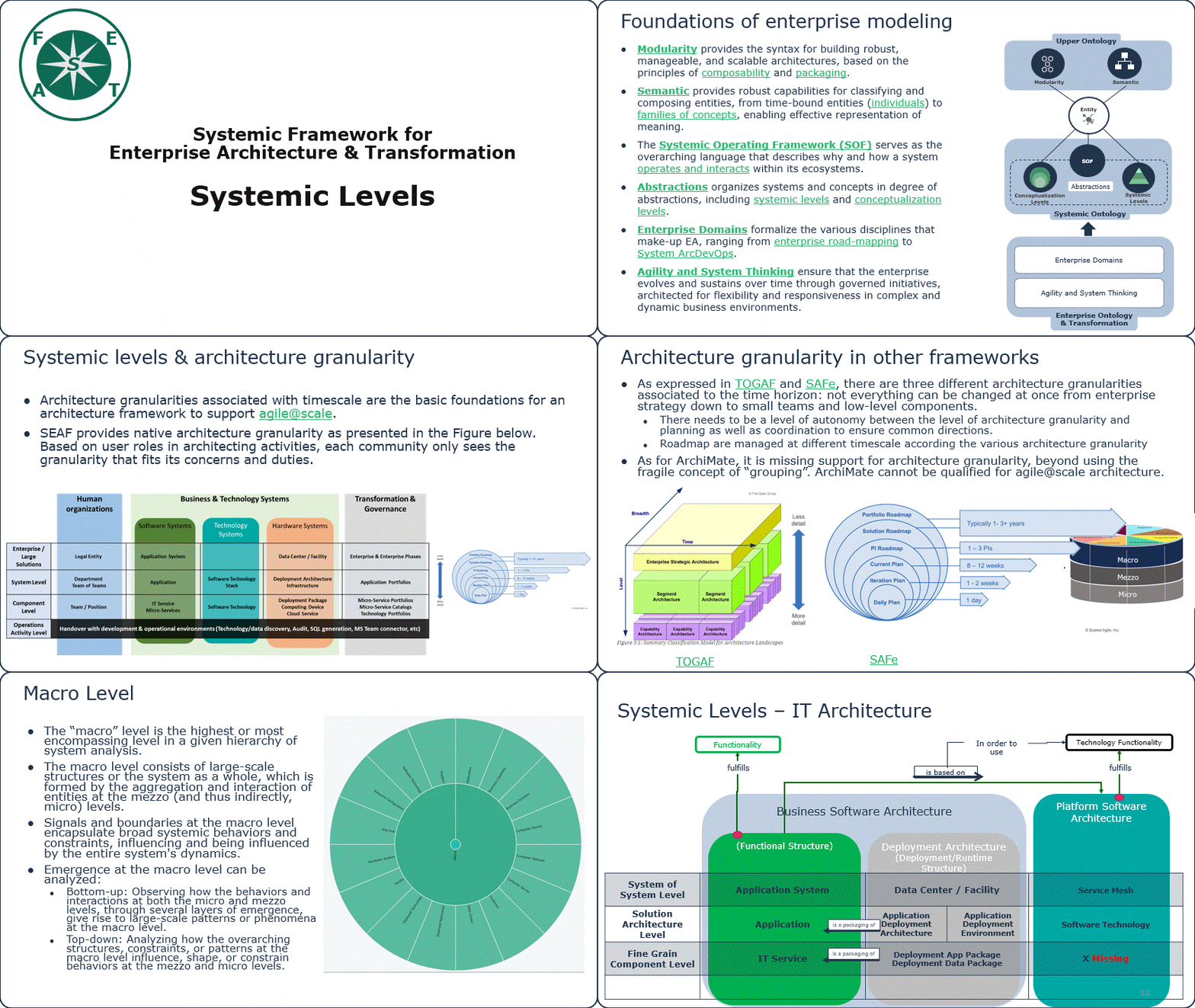
 Macro | The Macro level refers to the broadest level of analysis, which looks at large-scale enterprise assets. This level of analysis is concerned with understanding how large enterprise systems operate and how they interact with each other. Examples of macro-level systems are Application Systems, legal entities, the internet, System of Systems or the Enterprise itself. |
|
Mezzo | The Mezzo level is an intermediate level of analysis that focuses on the interactions between groups or organizations within a larger system. This level of analysis is concerned with understanding how groups work together and how they affect each other. Examples of mezzo-level phenomena include Applications, Departments, Facilitys. |
|
Micro | TheMicro level is the smallest level of analysis and focuses on individual behavior and small-scale interactions. This level of analysis is concerned with understanding how individuals interact with each other and with the larger systems around them. Examples of micro-level phenomena include individual attitudes, behaviors, and interpersonal relationships. |
|
Systemic and Conceptualization Levels | The Systemic and Conceptualization Levels domain defines the different granularities in which a complex system can be described or analyzed, by decomposition and analysis of interactions, at each level of composition (holonymy). |
 Systemic Levels | Systemic Levels refer to the hierarchical levels of granularity (Macro, Mezzo, Micro) in which a complex system can be described or analyzed by decomposition and analysis of interactions, at each level of composition. Systemic Levels help model the structure and behavior of complex systems to understand how individual elements come together to form a coherent whole, and how system properties and functionality emerge from their interactions at different levels. Emergent properties result from nonlinear interactions, feedback, and self-organization that occur at different Systemic Levels, and are often difficult to anticipate or control. Emergence is a key concept for understanding the complexity, resilience and evolution of complex systems. |