CONCEPT DOMAIN - Functional Asset and Operating Constraints
| Description | Pattern Domain The Functional Asset and Operating Constraints domain defines Directives and Behavioral Rules that constrain enterprise structures (Agent Types structure) and Behavior Types. |
|---|---|
| External references |
 OMG - BMM - Directive OMG - BMM - Directive
|
| Dictionary |  SysFEAT System Operating Framework
 |
| Parent Domain |  Systemic Operating Ontology
 |
| Domain dependencies |
4D Composite Knowledge Graph
Architecture Assets
Architecture Packages
Compositionality |
DOMAIN CONCEPT GRAPH
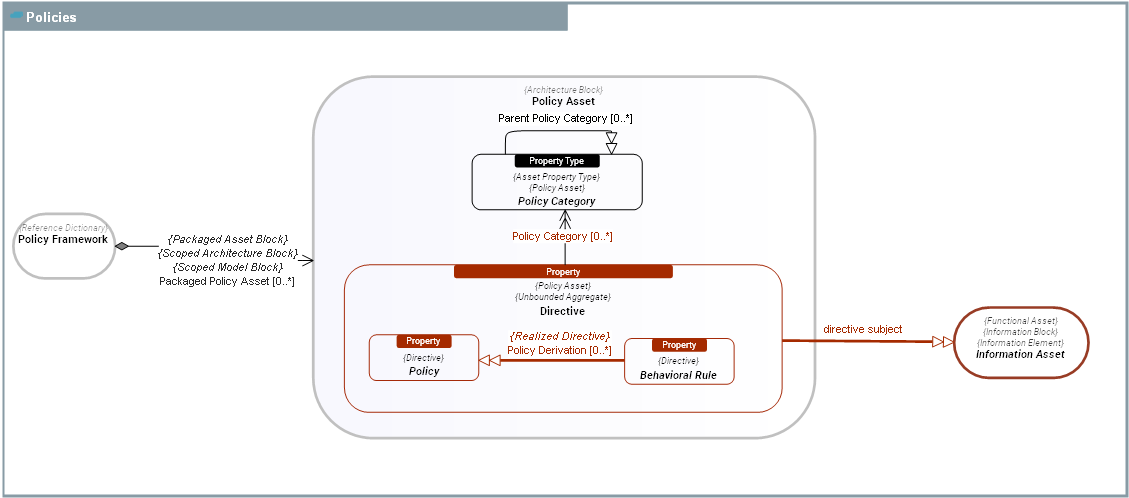
CONCEPT DESCRIPTIONS
ABSTRACT CONCRETE
| Concept | Description |
|---|---|
 Asset Type
 |
An Asset Type is a Class of Individual which is used in the description of the enterprise and its systems, such as Action Process Typees, Department Types, Applications, Location Types, Period Types.
|
 Behavioral Rule
 |
A Behavioral Rule is a Directive intended to guide the Behavior of Agent Types, in compliance with enterprise Policy(ies) or regulations. Often, a Behavioral Rule is derived from a Policy. Behavioral Rules are enforced in Processes and Agent Types.
|
|
Directive |
A Directive is an authoritative declaration that indicates how Agent Types and their Behavior Types should be (or should not be) in the enterprise. Specifically, a Directive defines, constrains or liberates some aspects of an Agent Type and its Behavior Types. As such, Directives shall be considered as constraning Asset Propertys. Directives are intended to assert agent structures or to control or influence their Behaviors. Directives are stated in declarative form.
|
|
Functional Asset |
Functional Assets encompasse all Asset Types used to describe why and how systems operate/function. This includes the Operating Eco-System where system operates to fulfill these purposes (Agent Types and their Behavior Types). Functional Assets include: 1. Blocks defining results of Behavior Types of the enterprise or its sub-systems, that benefit to it internal or external customers : Outcome Event, 2. Blocks used to describe information: Information Asset. 3. Blocks used to describe how the enterprise operates: Operating Asset Types (Agent Type, Behavior Type, Service Interface).
|
|
Policy |
A Policy is a Directive that is not directly enforceable whose purpose is to govern, guide or constrain the structure and Behavior Type of Agent Types in the enterprise. Policies provide the basis for rules and govern Behavior Types carried out by Agent Types.
|
 Policy Asset
 |
A Policy Asset is any topic related to policy definitions. It ranges from the different kinds of Directives (Business Policy, Architecture principle, Behavioral Rule, etc.), to classification of policies (Policy Category) up to an entire set of policies (Policy Framework). |
 Policy Category
 |
A Policy Category is a classification of policies. In regulations, it represents sections of the law.
|
|
Policy Framework |
A Policy Framework is a set of Policy Assets, defined in laws published by governements or in policy frameworks defined by the enterprise. Both Business Policy Frameworks and Regulatory Frameworks are Policy Framework(ies).
|
 Risk Type
 |
A Risk Type is a distinct category or classification of risk based on its origin, nature, or potential impact. It helps in organizing and addressing different sources of uncertainty or potential harm that an individual, organization, or system might face. By categorizing risks into different types, entities can develop more targeted mitigation strategies and response plans. Common risk types include Operational Risk Type, Privacy Risk Type, and Compliance Risk Type, among others, |
LOGICAL FORMULATION
AGDA RDF