CLASS OF CONNECTION - Temporal Bounding
| Description |
Abstract Concept
A Temporal Bounding is an Individual whose temporal extent is instantaneous, and whose spatial extent corresponds with the start or end of the Bounded Individuals for which it is the temporal border. Example: . The Eiffel tower completion (31st March 1889) . William Shakespeare birth (1564) . Confucius death (758). . Start of the first Plinian phase of the Mount Vesuvius eruption (18h, Aug. 24 A.D. 79) . Oakland hospital opening in 1994.
|
||
|---|---|---|---|
| Super Types |  Individual (from partition:
Structural Partition of Individual)  Ordering Connection | ||
| Power Type |  Temporal Bounding Type | ||
| Dictionary |  SysFEAT Upper Ontology |
RELATIONSHIPS
Simple Graph Graph & Inheritance Table
Simple Graph
Composition: ➝ Classification: ➝ Specialization: ➝ Instance Of: --> Enumerated definition: ➝ Syntax: ➝
LOGICAL FORMULATION
LOGIC-AGDA RDF
File: 267b6a126675a0b9.agda
CONNECTION DIAGRAM
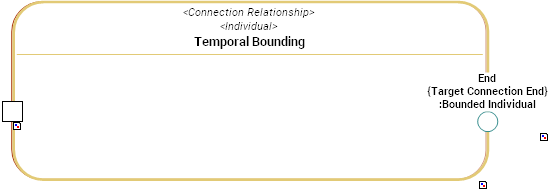
CONNECTION ENDS
| Name | Type | Super Type | Description | |
|---|---|---|---|---|
| Source End |  Start |
Bounded Individual |
Ordering Connection::Antecedent | |
| Target End |  End |
Bounded Individual |
Ordering Connection::Consequent |
SEMANTIC TAXONOMY
Sub-Types Super-Types
SUB-TYPES
Click node rectangle to collapse/expand one level. Click triangle for full recursive collapse/expand. Double-click on a node to open its URL. Hover for description.