CONCEPT DOMAIN - Resolution & Decision
| Description | Pattern Domain The Resolution & Decision domain defines constructs used by stakeholders to assess and qualify Functional Assets. |
|---|---|
| Dictionary |  SysFEAT System Operating Framework
 |
| Parent Domain |  Governance Pattern
 |
| Domain dependencies |
4D Composite Knowledge Graph
Appraisal Pattern
Architecture Packages
Functional Asset and Operating Constraints |
DOMAIN CONCEPT GRAPH
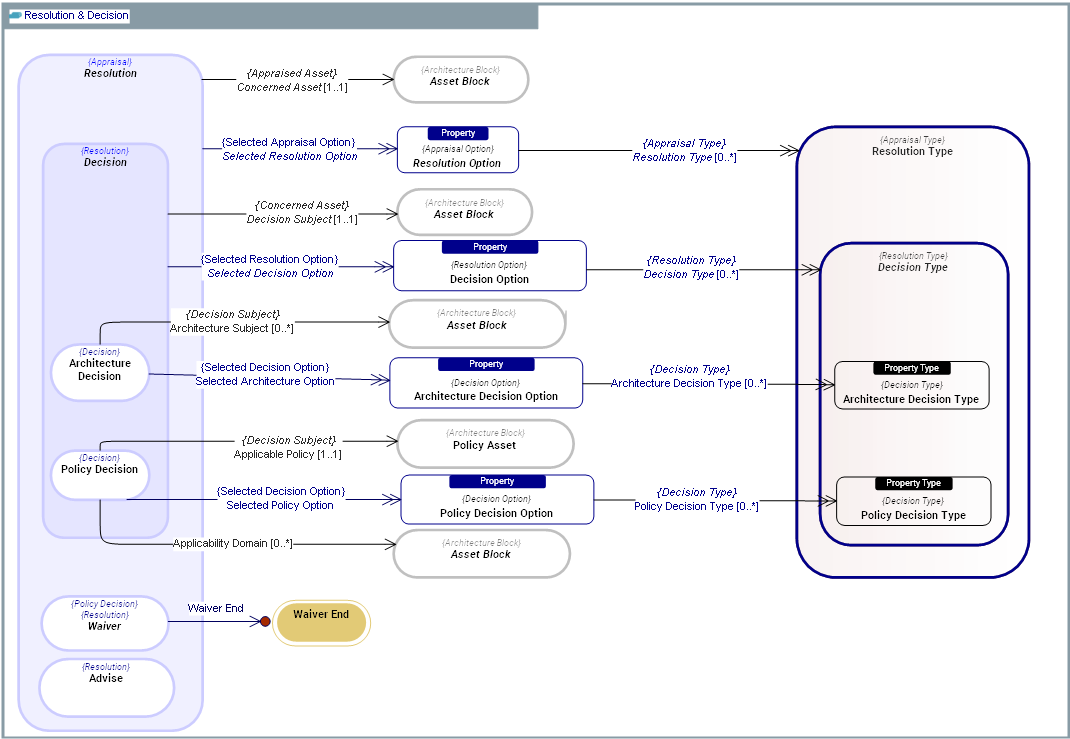
CONCEPT DESCRIPTIONS
ABSTRACT CONCRETE
| Concept | Description |
|---|---|
 Asset Block
 |
An Asset Block is an Architecture Block used to describe the System Operating Framework - SOF of the enterprise and its systems. |
 Decision
 |
A Decision is a time bound Resolution, agreed upon by Stakeholders, to state what shall or shall not be done regarding a specific Functional Asset. Architecturally significant decisions that are been made in the organization typically includes: a) Product selections b) Justification for major architectural features of projects c) Standards deviations d) Standards lifecycle changes e) Change Request evaluations and approvals f) Re-use assessments |
 Decision Outcome
 |
A Decision Outcome is a possible value of a Decision Type, that will be selected during a decision-making process. For instance, when making decisions about invesment on an enterprise asset, the possible options are: eliminate, invest, migrate, tolerate. |
 Decision Type
 |
A Decision Type is a Resolution Type that refers to a kind of Decision used to state what shall or shall not be done regarding an enterprise Asset Block. Decision Types define a set of Decision Options which are the possible values that will result from a decision-making process. For instance, when making decisions about invesment on an enterprise asset, the possible options can be: eliminate, invest, migrate. |
 Functional Asset
 |
Functional Assets encompasse all Asset Types used to describe why and how systems operate/function. This includes the Operating Eco-System where system operates to fulfill these purposes (Agent Types and their Behavior Types). Functional Assets include: 1. Blocks defining results of Behavior Types of the enterprise or its sub-systems, that benefit to it internal or external customers : Outcome Event, 2. Blocks used to describe information: Information Asset. 3. Blocks used to describe how the enterprise operates: Operating Asset Types (Agent Type, Behavior Type, Service Interface).
|
 Policy
 |
A Policy is a Directive that is not directly enforceable whose purpose is to govern, guide or constrain the structure and Behavior Type of Agent Types in the enterprise. Policies provide the basis for rules and govern Behavior Types carried out by Agent Types.
|
|
Policy Decision |
A Policy Decision is a Decision that defines the applicability status of a Policy to a set of Functional Assets. Example: A Policy Decision on the applicability of the RGPD regulation to specific enterprise data assets can have the result: Applicable or Non applicable. |
|
Resolution |
A Resolution is time bound Appraisal, agreed upon by Stakeholders to guide what can or cannot be done regarding a specific Functional Asset.
|
|
Resolution Outcome |
A Resolution Outcome is a possible value of a Resolution Type, that will be selected during a Resolution process. For instance, when making decisions about invesment on an enterprise asset, the possible options are: eliminate, invest, migrate. tolerate. |
|
Resolution Type |
A Resolution Type is an Appraisal Type that refers to a kind of Resolution used to guide what can or cannot be done regarding a specific Asset Block. Resolution Types define a set of Resolution Options which are the possible values that will result from a resolution process. For instance, when making decisions about invesment on an enterprise asset, the possible options can be: eliminate, invest, migrate. |
 OMG - UAF - UAFElement
LOGICAL FORMULATION
AGDA RDF