CLASS OF CLASS OF INDIVIDUAL - Action Process Type
| Description |
Abstract Concept
An Action Process Type is a Behavior Type that describes a typical course of action intended to produce Outcomes, through the involvement of Agent Types as Active Participants. During its course of action, a process consumes or produces Functional Assets, including Information Assets. 1) It may memorize or access Information Assets from and to its Process Stores. 2) It may receive Functional Assets at its boundary: Outcome Consumptions. 3) It may signal the production of Functional Assets at its boundary: Outcome Productions. The course of actions of a Action Process Type is constrained ( Rule Enforcement) by the application of Behavioral Rules that define what is allowed and not allowed to do. Within SysFEAT, we can examine Action Process Typees from two distinct perspectives: a) A conceptual standpoint is provided by Value Streams. b) A concrete implementation standpoint is provided by Resource Action Processes.
Conceptualization Levels of Action Process Type: an Action Process Type is either a Resource Action Process or a Value Stream
|
||
|---|---|---|---|
| External references |
 ISO 15926 - ClassOfActivity ISO 9000 - 3.4.1 - Process Merriam Webster - Process OMG - BPMN - Process OMG - UAF - Process OMG - UML - Activity OpenGroup - ArchiMate - Process Russell Ackoff - System of Concepts - Process WordNet - Process ISO 15926 - ClassOfActivity ISO 9000 - 3.4.1 - Process Merriam Webster - Process OMG - BPMN - Process OMG - UAF - Process OMG - UML - Activity OpenGroup - ArchiMate - Process Russell Ackoff - System of Concepts - Process WordNet - Process | ||
| Super Types |  Behavior Type (from partition:
Structural Partition of Behavior Type)
Behavior Type (from partition:
Structural Partition of Behavior Type) | ||
| Power Type of |  Individual Process
 | ||
| Dictionary |  SysFEAT System Operating Framework
 | ||
| Lexical Scope |  Architecture Container
 | ||
| Framework Mapping |
ArchiMate - Generic Metamodel : Action Process Type UAF - Parameters : Action Process Type UAF - Personal Views : Action Process Type UAF - Resource Views : Action Process Type UAF - Security Views : Action Process Type UAF - Resource Views : Action Process Type UAF - Operational Views : Action Process Type |
RELATIONSHIPS
Simple Graph Graph & Inheritance Table
Simple Graph
Composition: ➝ Classification: ➝ Specialization: ➝ Instance Of: --> Enumerated definition: ➝ Syntax: ➝
LOGICAL FORMULATION
LOGIC-AGDA RDF
File: d682ef5e56144e77.agda
SEMANTIC TAXONOMY
Sub-Types Super-Types
SUB-TYPES
Click node rectangle to collapse/expand one level. Click triangle for full recursive collapse/expand. Double-click on a node to open its URL. Hover for description.
BORDERS
| Name | Super type | Border Type | Description |
|---|---|---|---|
| Behavior Temporal Border |  Bounded Individual::Temporal Border
 |  Behavioral Event
 | |
| End Event |  Operating Asset Type::Operating Exit
  Behavior Type::Behavior Temporal Border Behavior Type::Behavior Temporal Border |
Behavioral Event | An End Event is a temporal border of a Behavior Type representing the production of a Behavioral Event that ends it. |
| Input |  Behavior Type::Start Event
 |
Outcome Event | An Input is a border of a Behavior Type that refers to the reaction to an Outcome Event that starts the Behavior Type. |
| Output |
Behavior Type::End Event |
Outcome Event | An Output is a border of a Behavior Type that refers to the production of an Outcome Event that ends the Behavior Type. |
| Start Event |
Operating Asset Type::Operating Entry Behavior Type::Behavior Temporal Border |
Behavioral Event | A Start Event is a temporal border of a Behavior Type representating its reaction to a Behavioral Event that starts it. |
INTERNAL STRUCTURE
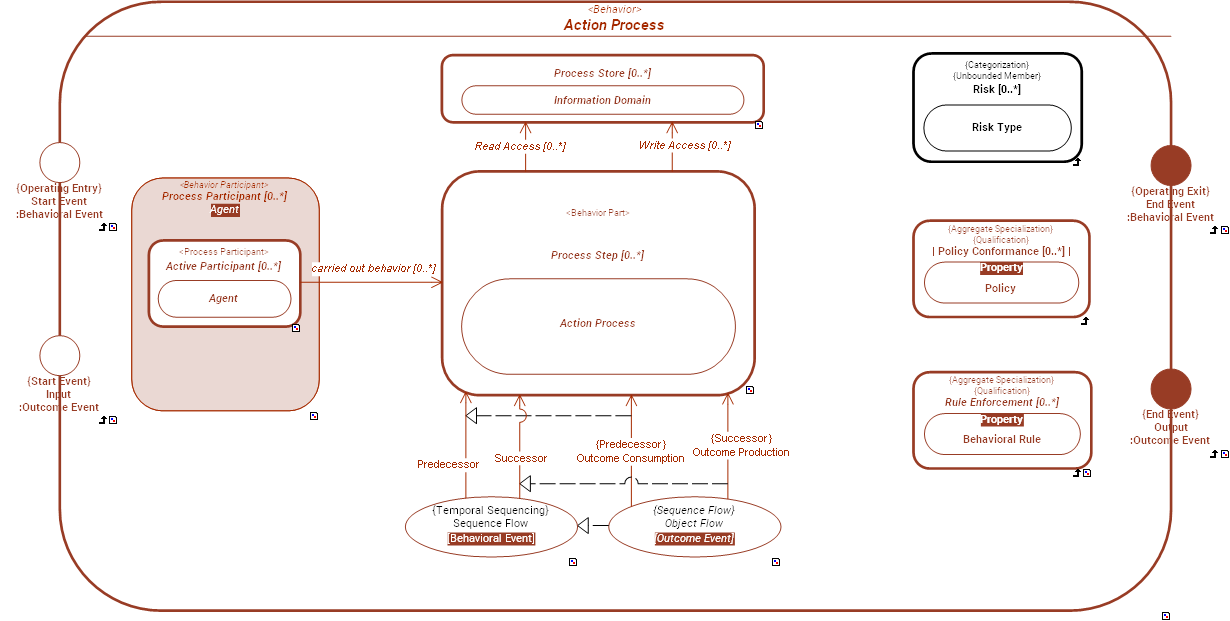
CONNECTORS
| Connector | Source | Target | Connector Type | Description |
|---|---|---|---|---|
 Object Flow Object Flow |
 Process Step.
Output
Process Step.
Output |
Process Step.
Input |
Outcome Event |
Abstract Connection Object Flow is a Sequence Flow that convey from its source
|
| Sequence Flow |
Process Step.
End Event |
Process Step.
Start Event |
Behavioral Event |
Abstract Connection A Sequence Flow is used to show the order in which steps of a process will be performed. Each sequence flow has only one source and only one target.
|